The Man on the Bridge: An Encounter That Crossed Souls
By: Special Correspondent
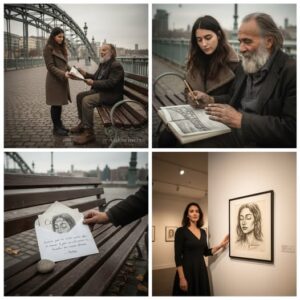
Every morning, as the city awoke and the first rays of sunlight spilled over the rooftops, Clara crossed the bridge that connected her quiet residential neighborhood to the bustling city center. The bridge was more than just a passage—it was a daily ritual, a transition between the comfort of home and the demands of work. Yet, for Clara, the bridge held another constant: a man who sat silently on the same weathered bench, day after day.
He was easy to overlook—his clothes were torn, his shoes barely held together, and his beard was as thick as his silence. He never asked for anything. He never disturbed anyone. He simply existed, gazing at the river that flowed beneath the bridge, lost in thought or memory.
Some passersby left him a cup of coffee, others tossed a coin his way. Most, however, turned their faces away, eager to avoid the discomfort of acknowledging his presence. For Clara, he was a fixture in her mornings—a silent witness to her daily journey.
One rainy morning, Clara was rushing to work, her mind occupied with deadlines and meetings. In her haste, she dropped her sketchbook right beside the man on the bench. She barely noticed, but he did.
“Miss… is this yours?” he called out, his voice rough but gentle.
Clara stopped in her tracks, surprised. No one had ever heard him speak before. She retraced her steps, slightly embarrassed.
“Yes… thank you,” she replied, reaching for the sketchbook.
“Do you draw?” he asked, his gaze steady.
“I try,” Clara admitted, nervous.
He flipped through a few pages before handing it back.
“You have a good eye… but you draw with fear.”
Clara frowned, unsure how to respond.
“Fear?”
“Yes. You try so hard to make it beautiful… you don’t let it be true.”
She stared at him, incredulous. What could he possibly know about her art?
“How do you know?” she challenged.
“Before I sat on this bench every day… I was an art professor. At the university. Until life taught me something different.”
Clara was speechless—not out of doubt, but because something in his tone demanded respect, not pity.
“May I teach you something?” he asked.
“Now?”
“Do you have five minutes?”
She hesitated, then nodded. He sat beside her, pulled out his own battered sketchbook, and asked her to draw the bridge—without looking at the paper.
“Feel the texture. Don’t control it. Let the pencil speak without fear.”
Clara obeyed. The result was awkward, messy, but alive.
“See?” he said, smiling. “Sometimes, imperfection is the most honest thing we have.”
From that day on, Clara crossed the bridge ten minutes earlier each morning. Sometimes they sketched together, sometimes they simply talked—about painting, about music, about life. The bench became their studio, their sanctuary.
One morning, the bench was empty. The man was gone. Clara searched for him, but found only a small envelope beneath the bench, her name written on it.
Inside was a charcoal drawing—Clara, seated on the bench, eyes closed, sketching with abandon. There was a note:
“Thank you for not looking away. Sometimes bridges don’t just cross rivers… they cross souls.”
—Mateo
Months later, Clara held her first exhibition. In the center of the gallery, under a warm light, hung the portrait Mateo had left her. The title: “The Man on the Bridge.” Beneath it, written in pencil:
“We all carry someone inside who waits to be seen, not judged.”
A Silent Witness to the City’s Pulse
For most, the bridge was nothing more than a shortcut, a means to an end. But for Clara—and for Mateo—it was a place where two worlds collided. The story of their encounter spread quietly through the neighborhood, whispered among those who had once ignored the man on the bench.
Who was he, really? Some said he had lost everything in a fire. Others claimed he had simply given up after a personal tragedy. What mattered, though, was not his past, but the impact he had on Clara—and on everyone who learned her story.
Clara’s exhibition drew crowds from across the city. Her work was raw, honest, and imperfect. Critics praised her for her emotional depth, her willingness to embrace vulnerability. But Clara always credited Mateo—the man whose lessons transcended technique and touched something deeper.
Art, Connection, and the Courage to See
“I used to draw what I thought people wanted to see,” Clara explained at the opening of her show. “Mateo taught me to draw what I feel—even if it’s messy, even if it’s uncomfortable. He showed me that true art isn’t about perfection. It’s about truth.”
Visitors lingered beneath the portrait of Clara on the bench, moved by the story behind it. Some left notes, others simply stood in silence, reflecting on their own encounters with people they had overlooked.
For the neighborhood, the bridge became a symbol—not just of transit, but of connection. People began to pay more attention to those they passed each day. A few even started leaving sketches and poems on the bench, hoping that Mateo might return.
A Lesson That Endures
Clara never saw Mateo again. Some say he moved on, others believe he found peace. But his lesson remained, etched not just in Clara’s art, but in the hearts of those who heard her story.
“We all carry someone inside who waits to be seen, not judged.” The words became a quiet mantra in the community—a reminder to look beyond appearances, to seek the stories hidden beneath the surface.
For Clara, the bridge was no longer just a path to work. It was a place where she had learned to see, to listen, and to create without fear. Her art flourished, but more importantly, so did her empathy.
The man on the bridge may have vanished, but the soul of his lesson endures. Every morning, as Clara crosses the bridge, she glances at the empty bench, remembering the encounter that changed her life—and, in subtle ways, the lives of many others.