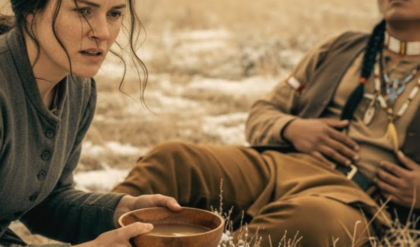
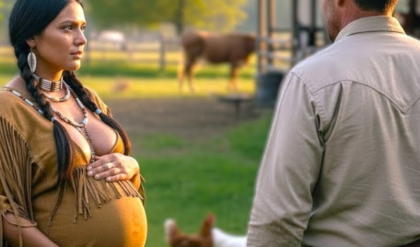
«¿Te CASARÍAS con mi HIJA GIGANTA? La viuda pobre se lo suplicó TODO el pueblo… ¡SOLO UN RANCHERO…
Thirty Days for Prudence
In the highlands of Montana, back in 1887, when the wind whistled through the pines and wolves howled at the full moon, there was a lost little town called Two Rivers. Just thirty wooden houses, a half-ruined Baptist church, a saloon that smelled of cheap whiskey, and a bank that owned nearly every soul in town.
On the outskirts, by the wild river that rushed down from the Rockies, lived Doña Refugio Asford with her daughter, Prudence. Her husband, Don Esteban, had died two winters before, crushed by a wild bull. Since then, the Billings Bank sent letters every month: “Pay up or lose your land.” Doña Refugio could no longer work; her hands shook and her knees creaked like dry branches.
.
.
.

Their only hope was to marry off Prudence before the final deadline, because the law said a married woman could keep the property of her deceased husband.
But the problem was Prudence.
Prudence Asford stood six feet eight inches barefoot. Her shoulders were broader than any man in the county, and her arms looked carved from oak. Since childhood, she’d been called the giant, the monster, the beast of Two Rivers. Men stepped aside when she passed, women crossed themselves, and children ran screaming, “Here comes the ogre!”
Forty-two suitors had been rejected by Doña Refugio on behalf of her daughter. Or rather, forty-two men had fled in terror as soon as they saw her.
One October morning, with the air smelling of pine and wood smoke, Doña Refugio hitched up the old mule to the cart and said,
“Today we settle this, daughter. We’re going to town. If no one wants you, let them say it to my face.”
Prudence put on her only Sunday dress—a brown suede one with fringes her mother had sewn years ago, now too short on the sleeves and hem. She climbed into the cart, ducking her head so as not to hit the roof, and they set off for Two Rivers.
The plaza was full. It was Saturday, market day. Men drank beer at the saloon door, women traded eggs for coffee, and children played cowboys. When the Asford cart appeared, a hush fell—even the dogs stopped barking.
Doña Refugio struggled to the center of the square and, with a trembling but firm voice, called out:
“Men of Two Rivers, for the last time, does anyone want to marry my Prudence? She’s strong, hardworking, honest, and a good Christian. Whoever marries her saves our land and wins the best woman Montana has ever seen.”
A graveyard silence, then laughter, then jeers.
“She should marry a bear, Doña Refugio!”
“Better keep her to scare off the Indians!”
“I don’t want to wake up one morning and be crushed by accident!”
Prudence sat in the cart, head bowed, fists clenched on her knees. Every word was a stone added to her heart, already full of scars.
Then, from the back of the crowd, a man stepped forward. He was tall, though not as tall as her. He wore a battered cowboy hat, a leather vest, and a beard of several days. His eyes were a dark blue, almost black, and in them was something Prudence had never seen directed at her—calm.
His name was Elias Mercer.
Three years before, his wife Clara and their unborn child had died in childbirth. Since then, he lived alone on his ranch, The Silence, ten miles upriver, talking more to horses than people.
Elias took off his hat, stood before the cart, and looked directly at Prudence—not her mother.
“Miss Asford,” he said, his voice rough but clear, “I didn’t come to mock. I came to offer something different.”
The laughter died. Everyone wanted to hear.
“I won’t lie. I never thought I’d marry again. But I saw your eyes when your mother spoke, and I saw my own reflected there. I’m alone too. I carry a pain no one understands. So I’ll make you this offer, and I say it to you, not your mother. Give me thirty days.
Come live on my ranch, or I’ll come to yours—however you prefer. We’ll work together, talk, get to know each other. If after thirty days you don’t want to marry me, I’ll leave and you’ll never see me again. No debt, no reproach. Word of honor.”
The silence was so deep, you could hear the river in the distance. Prudence looked up for the first time, met those dark eyes, and saw something she’d never been offered—respect.
“Why me?” she asked, her deep, almost masculine voice trembling.
Elias smiled, just a little, with sadness.
“Because you and I both know what it’s like to be the monster of the story. And I’m tired of being one alone.”
Doña Refugio wept without restraint. Prudence climbed down from the cart. The earth trembled when her boots hit the dust. She extended her massive hand, and Elias took it without hesitation. His fingers disappeared into her huge palm, but he didn’t flinch.
“Thirty days,” she said, “not one more, not one less.”
“Thirty days,” he replied.
That very afternoon, Elias loaded on his horse the few things Prudence wanted to bring: two dresses, her father’s Bible, and a blanket her mother had woven. Doña Refugio blessed them through tears and handed over a sack of beans and another of corn.

“Take care of her, Elias Mercer. She’s all I have.”
“I’ll protect her with my life, Doña Refugio.”
They set off for Prudence’s ranch—she wouldn’t leave her mother alone.
The first days were awkward. Elias arrived at dawn, and Prudence had already milked the four cows, chopped a week’s worth of wood, and repaired half a fence. He watched, amazed.
“Do you always work like this?”
“Always. If I don’t, who will?”
He smiled and joined her. Together, they lifted logs that would have taken four men. Together, they carried sacks of grain as if they were pillows. Together, they fixed the roof before the first snows.
At night, sitting by the fireplace, they talked—at first about anything: the weather, the wolves, the yield of the land.
Then, slowly, about deeper things.
One night, Prudence asked, “Were you never afraid of me? Everyone runs away.”
Elias threw another log on the fire.
“Clara was five feet nothing. Delicate as a cactus flower. I loved her with all my heart, but when I lost her, I learned that love isn’t about the size of bodies, but the size of souls. And yours, Prudence, is the biggest I’ve ever known.”
She cried for the first time in her life—unashamed.
Another night, Elias spoke.
“When I buried them, I swore I’d never love again. But you… you make me want to live again.”
By the fifteenth day, they’d stopped counting. They worked, laughed, and looked at each other in a way Doña Refugio recognized well—it was the same look she’d given Esteban forty years before.
One afternoon of early snow, while fixing the corral, Prudence twisted her ankle on an icy stone. She fell to her knees with a cry that sent the crows flying. Elias ran to her.
“Prudence!”
He tried to lift her, but she was too heavy, even for him. So she, through tears of pain and laughter, said,
“You can’t carry me, fool. Then I’ll stay here with you until you can walk.”
He sat beside her in the snow, wrapping her in his arms. The cold seeped into their bones, but neither moved.
There, in the mud and snow, they kissed for the first time—a clumsy, frightened kiss, but more honest than any word.
By the twentieth day, Prudence couldn’t sleep thinking about what would happen if he left. Elias couldn’t, either.
One morning, after milking, he knelt before her in the barn, holding a simple silver ring that had been his mother’s.
“I know we said thirty days. But I can’t wait anymore. Prudence Asford, will you marry me? Not to save the land, not out of pity, but because I love you with all I am, all I was, and all I’ll ever be.”
Prudence looked down from her height, tears running like rivers down her cheeks.
“Yes, Elias Mercer. A thousand times yes.”
They married the next Sunday in the little church of Two Rivers.
Father Omay nearly fell off the altar when he saw the bride enter—she had to duck to get through the door. The dress was sewn by the three of them: Doña Refugio, Prudence, and Widow Sanchez, the only seamstress who wasn’t afraid. It was white linen with lace, dyed brown to be less flashy, but Prudence looked like a queen of the mountains.
The whole town came to the wedding—some out of curiosity, some to gossip.
But when Elias put the ring on that huge finger and said, “Till death do us part,” and when Prudence replied in a voice that shook the rafters, “Till death do us part,” many bowed their heads in shame.
Years passed, as the wind passes over the prairies. The bank received its money right on the deadline. The land was deeded to Prudence and Elias Mercer. The farm prospered. They bought more cows, planted wheat, built a new barn tall enough for Prudence to walk in upright.
They had three children. The first, Esteban Elias, born in 1889, was as tall as his mother and as serious as his father. The second, Clara Refugio, in 1891, was small and delicate but with arms promising strength. The third, Santiago, in 1894, arrived screaming so loud the coyotes fell silent that night.
Prudence no longer hid. She walked through Two Rivers with her head held high, children in her arms or on her shoulders, and those who once called her a monster now greeted her with respect.
“Good morning, Doña Prudence,”
because they had seen how that woman saved her land, raised her children, and above all, made happy a man everyone thought was dead inside.
One autumn afternoon, thirty years after that day in the plaza, Elias and Prudence sat on the porch, watching their grandchildren play. He, now gray-haired, rested his head on her shoulder, still strong as an oak.
“Do you remember,” he said, “when I offered you thirty days?”
She laughed—a laugh that rattled the windows.
“Thirty days! You knew from the first moment you’d never leave.”
Elias took her huge hand in his.
“I once told you the greatest treasures are hidden behind what people fear most. And you told me love isn’t measured in inches or pounds, but in courage.”
They looked at each other.
They were no longer young, but their eyes still had the same spark as that first day.
“Thank you for having the courage to love me, Elias.”
“Thank you for letting me love you, my beautiful giant.”
And so, on the prairies of Montana, was written one of the most beautiful stories ever told—the story of a giantess who found a man brave enough to see her as she truly was, and of a man who found, in the strongest arms in the world, the softest place to heal his broken heart.
Because real stature is not measured from the ground to the head,
but from the heart to the sky.