For thirty years, he secretly sheltered a Bigfoot in his backyard shed—until the police arrived and the astonishing truth about the hidden Sasquatch was revealed.
It was the summer of 1992, and the woods behind the small town of Pine Ridge were thick with mist and legend. Old-timers swapped stories at the general store about strange footprints, eerie howls at midnight, and eyes gleaming in the darkness. But nobody took these tales seriously—except for one man.
Walter Grady was a recluse. At sixty-two, he lived alone in a weathered house at the edge of the forest, his only company the wild deer and foxes that sometimes wandered into his yard. Walter liked it that way. He spent his days tending his vegetable garden and his nights reading faded paperback novels, content to let the world pass him by.
But all that changed one humid July evening.
Walter was fixing a broken fence post when he heard a crash from deep in the woods. At first, he thought it might be a bear, but the sound was too heavy, too deliberate. He grabbed his old shotgun out of habit and crept toward the trees. The air was thick with the scent of pine and damp earth.
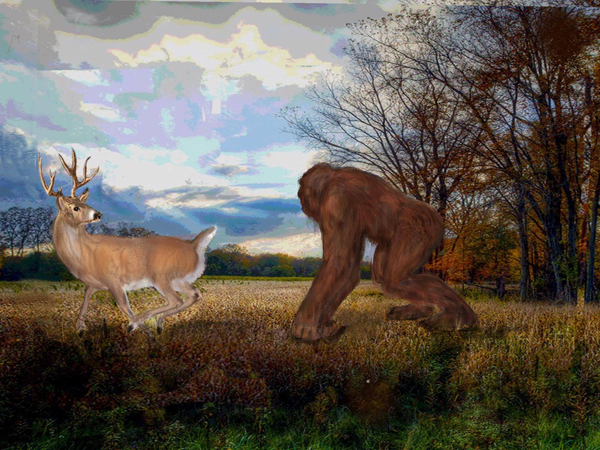
As he pushed through the undergrowth, Walter saw something that made his heart stutter—a massive, shaggy figure hunched over, clutching its arm. The creature was covered in dark brown fur, at least eight feet tall even when crouched. Its face was broad and flat, with deep-set eyes that glimmered with pain and fear.
Walter froze. The stories were true. Bigfoot was real, and he was bleeding.
For a moment, man and beast stared at each other. Then the creature let out a low, mournful groan. Walter saw blood soaking the fur around its arm—a jagged wound, fresh and ugly.
Against all logic, Walter lowered his gun. “You’re hurt,” he whispered.
The creature flinched but did not run. Walter inched closer, heart pounding, and saw a rusty trap clamped onto the beast’s arm—one of the old steel-jaw traps that hunters sometimes left behind.
Carefully, Walter knelt and spoke in a gentle voice. “It’s okay. I’m not going to hurt you.”
He reached out, hands trembling, and unlocked the trap. The creature recoiled, but when the metal snapped open, it whimpered softly. Walter pulled a clean rag from his pocket and wrapped the wound, working by instinct.
When he finished, the creature regarded him with wary eyes. Walter stood up, unsure what to do next.
“Come on,” he said. “You can’t stay out here.”
He led the injured Bigfoot back to his shed—a sturdy structure behind his house, filled with tools and old furniture. The creature ducked inside, curling up in the corner.
Walter shut the door and locked it, his mind racing. What had he just done?
The next few days passed in a blur. Walter brought food and water to the shed—buckets of rainwater, apples from his garden, and slabs of venison from his freezer. The creature ate in silence, always watching him with those intelligent, haunted eyes.
Walter called him “Buddy.” It seemed less frightening, somehow.
Buddy healed slowly. Walter changed the bandages and cleaned the wound. Sometimes, he would sit in the shed and talk, telling Buddy about the world outside, about the stars, about the loneliness that sometimes crept into his bones.
Buddy never spoke, but Walter felt a strange connection growing between them.
At night, Walter worried. What if someone saw Buddy? What if the authorities found out? The town was small, but rumors spread quickly. He kept the shed locked and covered the windows with blankets. When neighbors dropped by, Walter made excuses—he was busy, he was sick, anything to keep them away.
But hiding a creature as large as Buddy was no easy feat.
One evening, as Walter was cleaning up after dinner, he heard a soft knock at the back door. He opened it and found Buddy standing there, hunched and nervous.
Walter ushered him back to the shed, whispering, “You can’t be seen out here, Buddy. It’s not safe.”
Buddy blinked, then shuffled inside.
Walter realized he couldn’t keep Buddy locked up forever. But what choice did he have?
Days turned into weeks, weeks into months. Walter built a routine around Buddy’s care. He expanded the shed, adding a small cot and a wood-burning stove for warmth. He taught Buddy simple gestures—pointing for food, shaking his head for “no.” They developed a wordless understanding.
Walter’s life changed. He stopped going to town except for essentials. He grew his own vegetables, hunted for meat, and kept to himself. The townsfolk whispered that Walter had gone crazy, but nobody came close enough to see the truth.
Buddy grew stronger. His wound healed, leaving only a scar. Sometimes, Walter would find him staring out the shed window, longing for the forest. But he never tried to escape.
Walter wondered if Buddy was lonely, too.
One snowy winter night, Walter sat in the shed, sipping coffee. Buddy watched him, eyes reflecting the flicker of the stove.
Walter spoke softly. “Do you ever think about leaving?”
Buddy tilted his head, then looked away.
“I guess we’re both trapped here,” Walter said.
Buddy reached out and touched Walter’s hand—a gesture of comfort.
Walter smiled, blinking back tears.

Years passed. Walter aged; his hair turned white, his steps slower. Buddy grew old, too, his fur streaked with gray.
Walter kept his secret. He wrote journals, filling pages with stories about Buddy, about their friendship, about the things he wished he could say.
But secrets are heavy. Sometimes, Walter dreamed of telling someone, of sharing the truth. But the fear was stronger.
In 2005, a new family moved in next door—a young couple with a dog that barked at everything. Walter worried Buddy would be discovered. He built a fence around the shed and planted thick hedges for cover.
One spring, the dog got loose and ran into Walter’s yard. It sniffed around the shed, barking furiously. Walter rushed outside, heart pounding, and dragged the dog away. The neighbors apologized, but Walter remained tense for weeks.
Buddy sensed the danger. He stayed hidden, moving only at night.
Walter’s health began to fail. He developed arthritis, his hands stiff and painful. But he kept caring for Buddy, refusing to let go.
It was the autumn of 2022—thirty years since Walter had first found Buddy in the woods.
Walter woke one morning to the sound of sirens. He looked out the window and saw two police cars parked in his driveway. His heart thudded.
He went outside, trying to look calm.
Officer Ramirez, a tall man with a kind face, approached. “Morning, Mr. Grady. We’ve had reports of strange noises coming from your property.”
Walter’s mind raced. “Probably raccoons. They get into my shed sometimes.”
Ramirez nodded, but his partner, Officer Lee, was less convinced. “Mind if we take a look?”
Walter hesitated, then led them to the shed. He unlocked the door, praying Buddy was hidden.
But Buddy was there, sitting quietly on the cot.
The officers froze.
Lee stepped back, hand on his gun. “What the hell is that?”
Walter stood between them and Buddy. “He’s not dangerous. He’s…he’s my friend.”
Ramirez stared, eyes wide. “Is that—Bigfoot?”
Walter nodded, tears in his eyes. “I found him thirty years ago. He was hurt. I couldn’t let him die.”
The officers didn’t know what to say.
Buddy stood, towering over them, but made no move to attack.
Walter spoke softly. “Please. He’s lived here all his life. He’s never hurt anyone.”
Ramirez lowered his gun. “We need to call this in.”
Walter nodded, knowing the secret was finally out.
News
I uncovered the horrifying truth about what Bigfoot does with human bodies—an unsettling Sasquatch discovery that will leave you questioning everything.
I uncovered the horrifying truth about what Bigfoot does with human bodies—an unsettling Sasquatch discovery that will leave you questioning everything. Late September 2014, near the Cascades, the wind had been picking up, making the trees sway and groan. It…
He recorded the moment Bigfoot spoke to him—chilling footage of a talking Sasquatch that reveals a terrifying encounter and a mystery beyond belief.
He recorded the moment Bigfoot spoke to him—chilling footage of a talking Sasquatch that reveals a terrifying encounter and a mystery beyond belief. My name’s Mark Hensley. I’m fifty now, living in Elkins, West Virginia. It’s late autumn, and I’m…
I captured footage revealing Bigfoot’s chilling secret: what really happens to human bodies in the wild—an astonishing discovery that will shock the world.
I captured footage revealing Bigfoot’s chilling secret: what really happens to human bodies in the wild—an astonishing discovery that will shock the world. My name’s Ray Dobson and I’m fifty-eight now. It’s November 2025, Schemania County, Washington. Cold rain…
A fisherman rescues a mysterious castaway, only to discover she’s a mermaid sent from the depths with a secret mission to connect with humanity.
A fisherman rescues a mysterious castaway, only to discover she’s a mermaid sent from the depths with a secret mission to connect with humanity. . . . . The morning sun hovered just above the horizon, casting a pale gold…
Un millonario apostó que nadie podría domar su caballo indomable, hasta que un niño humilde de la calle desafió las expectativas y sorprendió a todos.
Un millonario apostó que nadie podría domar su caballo indomable, hasta que un niño humilde de la calle desafió las expectativas y sorprendió a todos. . . . . I. El desafío de don Esteban En un pueblo polvoriento al…
Sin comida ni agua, solo la leche de la viuda apache mantuvo vivo al vaquero moribundo bajo el sol ardiente del desierto.
Sin comida ni agua, solo la leche de la viuda apache mantuvo vivo al vaquero moribundo bajo el sol ardiente del desierto . . . . El sol del desierto ardía como un hierro al rojo vivo sobre la piel…
End of content
No more pages to load