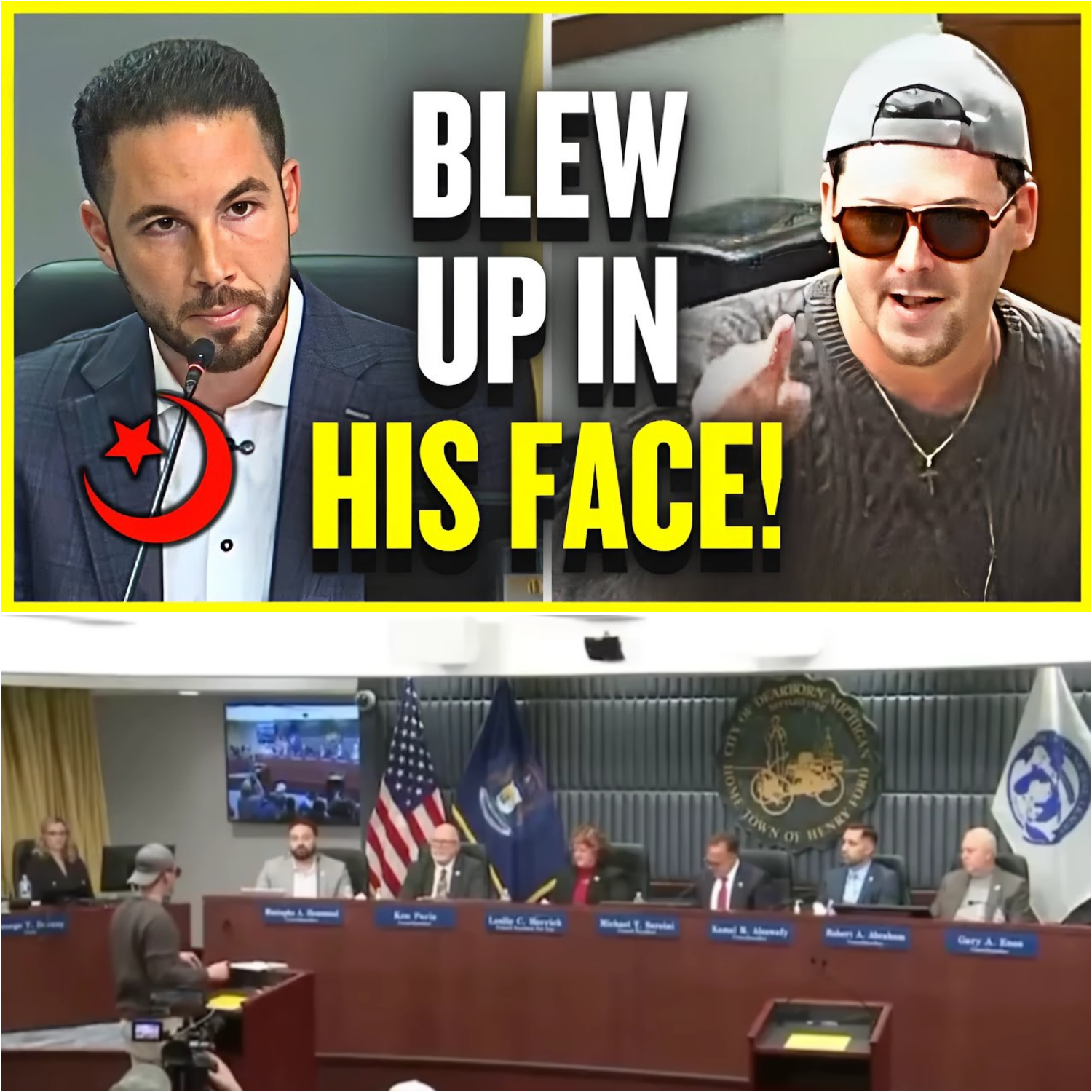
“Tensions Erupt at U.S. City Hall: Heated Debate Over Islamic Influence in Local Politics Leaves Officials Under Intense Public Scrutiny”
Confrontation in Dearborn: Free Speech, Policing and a City Under Scrutiny
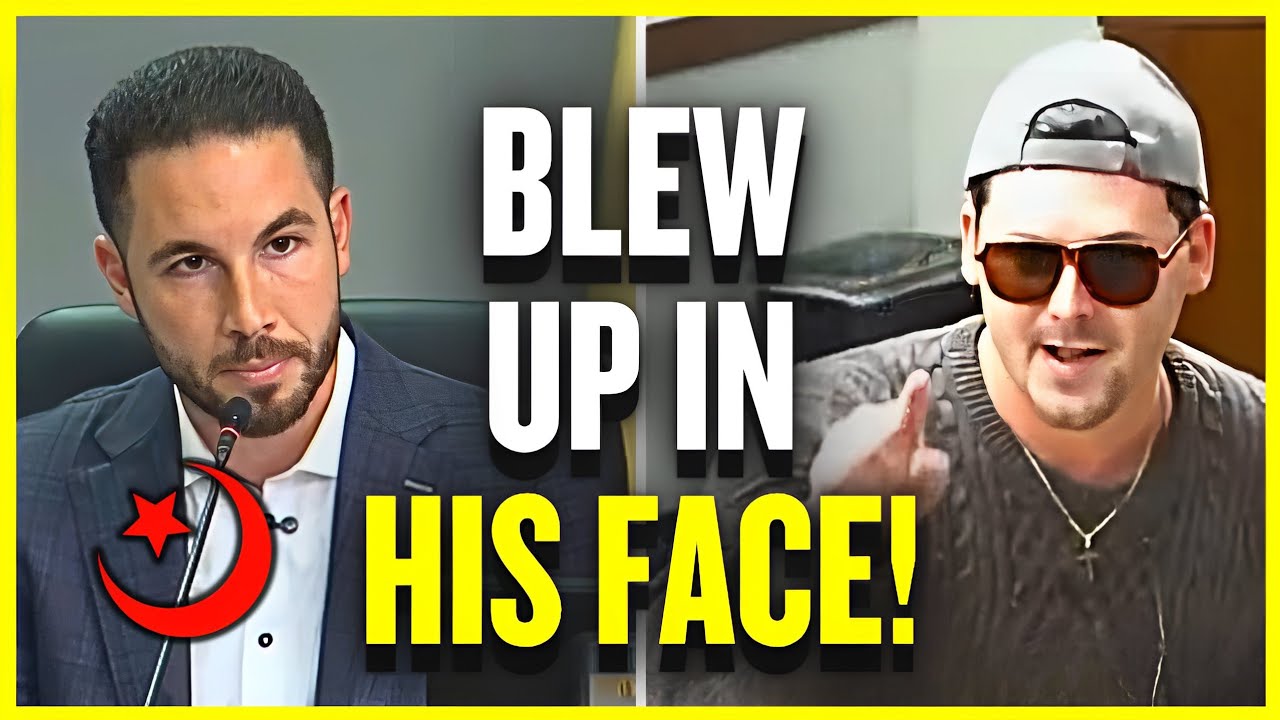
On a recent afternoon in Dearborn, a confrontation between a journalist and protesters spiraled into allegations of assault, theft and selective law enforcement — igniting a broader debate about free expression, religious tensions and policing standards in one of America’s most closely watched communities.
The episode unfolded on a public street during a demonstration that drew activists, counter-protesters and local police. Video footage later circulated online shows a chaotic scene: shouting crowds, officers standing at intervals and a journalist claiming he was pepper-sprayed and robbed after attempting to question demonstrators.
.
.
.
“I’m Doing My Job”
The journalist, who identified himself as a member of the press covering the event, said he approached a group of protesters to ask why they were confronting another individual who had sought dialogue. Moments later, he alleged, he was sprayed with a chemical irritant, his phone damaged and personal items taken from his pockets.
In footage recorded after the incident, he holds up a visibly cracked phone camera and recounts the theft of cash and equipment used for audio recording. He says he reported the incident to an officer at the scene, identified by badge number, and was told that a formal complaint would need to be filed at the station.
The exchange, captured on video, shows mounting frustration. The journalist argues that delaying action would allow the alleged assailant — dressed in black and masked — to disappear into the crowd. The officer responds that he cannot leave his assigned post.
Minutes later, the journalist films what he says is the same officer outside the immediate area, taking a phone call. He confronts him again, questioning why a personal call warranted stepping away when an arrest did not. The officer declines to engage further on camera.
The incident has fueled accusations online that law enforcement failed to respond appropriately to a reported assault. Dearborn police have not publicly detailed the specifics of the encounter but have said that individuals are encouraged to file formal reports so investigations can proceed through standard channels.
A City With a National Profile
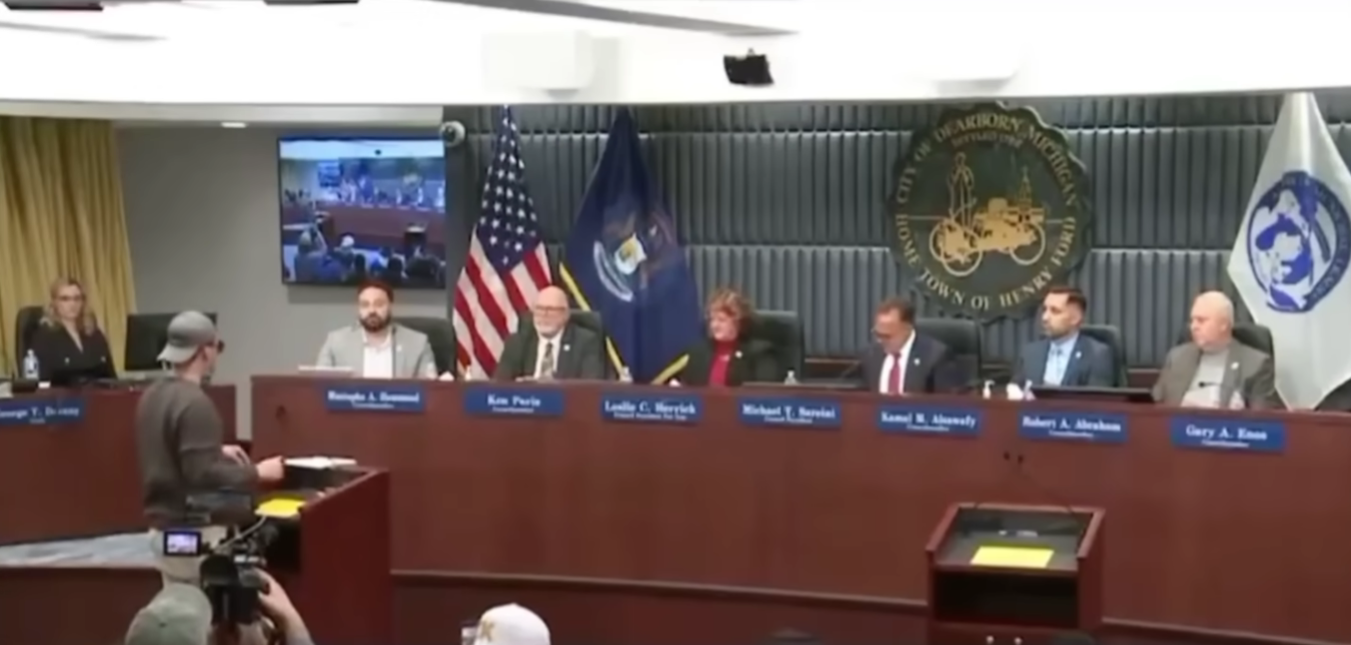
Dearborn, a city of roughly 110,000 residents just west of Detroit, has long drawn national attention for its large Arab American population. According to census data and academic estimates, it is one of the most concentrated Arab American communities in the United States, with many residents tracing roots to Lebanon, Yemen and other parts of the Middle East.
The city has also become a focal point in broader national conversations about Middle East politics, immigration and religious identity. Demonstrations tied to international conflicts have drawn both solidarity rallies and counter-protests, at times producing tense standoffs.
In the latest incident, the journalist described feeling like an outsider in his own country — language that resonated with some online commentators and alarmed others who saw it as inflammatory. He compared his experience to the concept of “dhimmi,” a historical term referring to non-Muslims living under certain Islamic empires, and accused city leadership of tolerating a climate of intimidation.
City officials have not endorsed that characterization. Community leaders in Dearborn have repeatedly emphasized that the city is home to people of many faiths and that most residents reject violence and harassment.
Free Expression and Provocation
Additional clips from the event show other confrontations. In one, an individual appears to provoke demonstrators by disrespecting a copy of the Quran, Islam’s holy book. The act draws immediate outrage from nearby protesters, and a physical altercation ensues.
The footage has reignited a familiar American tension: the legal protection of provocative speech versus the risk of violence it may trigger. The First Amendment safeguards expression — including speech that many consider offensive or sacrilegious — but it does not shield individuals from social backlash, nor does it protect acts of assault in response.
Civil liberties advocates note that the constitutional principle is clear: speech alone, absent incitement to imminent lawless action, cannot be criminalized. At the same time, law enforcement officials are often tasked with managing volatile crowds where emotions run high.
Allegations of “Two-Tier” Policing
The journalist and several commentators framed the police response as an example of “two-tier policing” — a phrase that has gained traction in some political circles to describe perceived inconsistencies in law enforcement depending on identity or ideology.
Critics argue that officers in certain politically sensitive situations may hesitate to intervene for fear of escalating tensions or being accused of bias. Law enforcement leaders, for their part, frequently contend that split-second decisions in crowded, unpredictable environments require balancing immediate safety concerns with longer-term investigative processes.
Experts in policing caution against drawing sweeping conclusions from isolated videos. Crowd control, they note, involves strategic positioning; officers assigned to fixed posts may be restricted from leaving without supervisory approval. Moreover, identifying masked suspects in real time can be operationally difficult without additional units.
Still, perception matters. When citizens believe laws are not enforced evenly, trust erodes. And in communities already grappling with polarization, viral clips can deepen suspicion on all sides.
A Broader Cultural Crosscurrent
The Dearborn confrontation comes amid heightened tensions nationwide. Protests connected to overseas conflicts have unfolded on college campuses, city streets and state capitols. In some places, clashes have turned physical; in others, law enforcement has been criticized for either heavy-handed tactics or insufficient intervention.
In Dearborn, demographic realities add complexity. The city’s Arab American community has faced discrimination in past decades, particularly after the September 11 attacks. Many residents view portrayals of their city as a hotbed of extremism as unfair and stigmatizing.
At the same time, critics argue that open debate about religious doctrine and political ideology must remain protected — especially in a country built on constitutional guarantees. When journalists or activists claim intimidation, it raises concerns about whether public spaces remain equally accessible to all viewpoints.
The Role of Social Media
Much of the national reaction has unfolded online. Short video clips, stripped of broader context, travel rapidly across platforms, often accompanied by commentary framing events as evidence of cultural “takeover” or systemic bias.
Media scholars warn that viral moments can distort reality. A heated altercation involving dozens of people does not necessarily reflect the daily life of a city of more than 100,000 residents. Yet such images shape perceptions far beyond municipal borders.
For Dearborn, a city accustomed to scrutiny, the latest episode underscores the difficulty of navigating local governance under national spotlight. City leaders must balance protecting constitutional rights, maintaining public safety and preserving community cohesion — tasks that become exponentially harder when incidents are magnified in real time.
Unresolved Questions
As of this writing, it remains unclear whether arrests will follow from the alleged assault on the journalist. The police department has procedures for reviewing officer conduct and investigating complaints, but those processes can take time.
What is clear is that the confrontation has tapped into deeper currents running through American society: fears about unequal enforcement of the law, anxieties over religious pluralism and the boundaries of free expression.
In a nation that prides itself on constitutional protections, the standard is demanding. The law must apply evenly, regardless of religion or ideology. Public spaces must remain open to speech — even offensive speech — without descending into violence.
Whether the events in Dearborn represent a breakdown of that balance or simply a volatile moment amplified by the digital age is a matter of perspective. For now, the city finds itself once again at the intersection of local incident and national debate — a reminder that America’s most enduring principles are often tested not in courtrooms, but on its streets.
News
🚨“U.S. Senator Under Fire: Kelly Slammed by Critics for Questioning Trump’s Iran Strikes as War Powers Debate Erupts Across America”
🚨“U.S. Senator Under Fire: Kelly Slammed by Critics for Questioning Trump’s Iran Strikes as War Powers Debate Erupts Across America” Democratic Lawmakers Split With White House After U.S.–Israel Strikes on Iran Washington, D.C. — A sweeping U.S.–Israeli military operation targeting…
BREAKING: U.S. Labels Iran “State Sponsor of Wrongful Detention” as Tensions Soar — Marco Rubio Issues Stern Warning Over American Detainees and Escalating Middle East Conflict
BREAKING: U.S. Labels Iran “State Sponsor of Wrongful Detention” as Tensions Soar — Marco Rubio Issues Stern Warning Over American Detainees and Escalating Middle East Conflict U.S. Accuses Iran of Detaining Americans as Tensions Reach Boiling Point Washington, D.C. —…

“Heated Debate Takes a Sharp Turn: Woman Defends Islam as Peaceful — Then Gad Saad Asks One Question That Leaves the Room in Stunned Silence”
“Heated Debate Takes a Sharp Turn: Woman Defends Islam as Peaceful — Then Gad Saad Asks One Question That Leaves the Room in Stunned Silence” Democracy, Faith and the Fault Lines of Citizenship . . . On a recent evening…
Oğlu, annesinin mezarının açılmasını ŞİDDETLE TALEP ETTİ. Ve tabut açıldığında POLİS çağrıldı
Oğlu, annesinin mezarının açılmasını ŞİDDETLE TALEP ETTİ. Ve tabut açıldığında POLİS çağrıldı Berlin’in dar, loş bir sokağındaki küçük dairesinde, Tuncay Karadeniz sabah kahvesini yudumluyordu. Soğuk bir Kasım günüydü. Pencereden süzülen soluk ışık, masanın üzerindeki pasaportu ve annesinin son doğum gününde…

Milyoner, annesini evsiz bir gence yaslanmış görünce donup kaldı… sonra onlara doğru koştu
Milyoner, annesini evsiz bir gence yaslanmış görünce donup kaldı… sonra onlara doğru koştu İstanbul’un kalbi, Taksim Meydanı’nın hareketli uğultusu. Her yer Aralık ayının keskin, soğuk ışığıyla yıkanıyordu. Siyah, zırhlı bir Mercedes Sınıfı, kırmızı ışıkta beklerken, içeride Kemal Demir oturuyordu. Daha…

Öğretmen, öğrencinin saçını sınıfta görünce hemen kesti. Sonrasında yaşananlar ise herkesi şok etti
Öğretmen, öğrencinin saçını sınıfta görünce hemen kesti. Sonrasında yaşananlar ise herkesi şok etti Sabah güneşi lise sınıfını aydınlatıyor ve yere yansıyordu. Kız sessizce masasında oturmuş, resim çiziyor ve dersin başlamasını bekliyordu. Uzun, kıvırcık saçları onun için özeldi; ona her…
End of content
No more pages to load