“The Woman Who Bought Three Chinese Orphans for $9—What She Did Next Will SHOCK You”
Clara hadn’t planned on stopping. The wind cut through the plains in a sharp, almost urgent way, but she didn’t need flowers or trinkets. She had long since stopped looking for those things. But something about the town’s dusty square made her steer the reins of her horse toward the small crowd that had gathered there. What she saw took her breath away.
Three boys stood before an auctioneer. Burlap sacks were tied over their heads, their hands bound behind their backs. No names, no stories—just the unsettling sight of human lives reduced to an auction price. “Chinese boys, $3 a piece,” the sign read. The auctioneer, a greasy man in sweat-stained suspenders, cleared his throat and eyed the crowd with greedy anticipation.
Clara’s boots struck the dirt, a deliberate sound that demanded attention. She stepped toward the group, her eyes narrowing as they landed on the three boys. The tallest one, his body swaying, was clearly older—perhaps eleven or twelve. The middle child had a fresh bruise under his eye, while the smallest boy, no more than six, stood eerily still, staring at Clara without flinching.
“$3 each,” the auctioneer repeated, his voice tinged with amusement. “Strong backs, good labor from the railroad camps.”
Clara stepped closer, her eyes fixed on the boys. She didn’t speak a word, but the auctioneer grew nervous under her unwavering gaze. “You sure about this, lady? These kids ain’t like ours,” he said, his voice wavering. “They don’t talk much, and they don’t cry either. Been starvin’ all day.”
Clara reached into her coat, pulling out a pouch with nine silver dollars inside. She pressed the coins into the auctioneer’s palm without a second thought.
“All three,” she said simply, her voice cutting through the air.
The crowd fell silent as the man hesitated. Finally, he stepped forward, knife in hand. One by one, he cut the ropes binding the sacks. The boys’ faces were revealed, each one carrying a different burden. The eldest boy had eyes far too old for his face, his jaw clenched but his gaze unwavering. The middle boy darted his eyes nervously, unsure who to trust. The youngest, however, stood firm, his gaze locked onto Clara.
She didn’t wait. “Come with me,” she said, her voice low, not giving anyone a chance to question her. The smallest boy took a tentative step, then another, and with a gentle tug on the edge of her coat, he whispered, “Please… stay.”
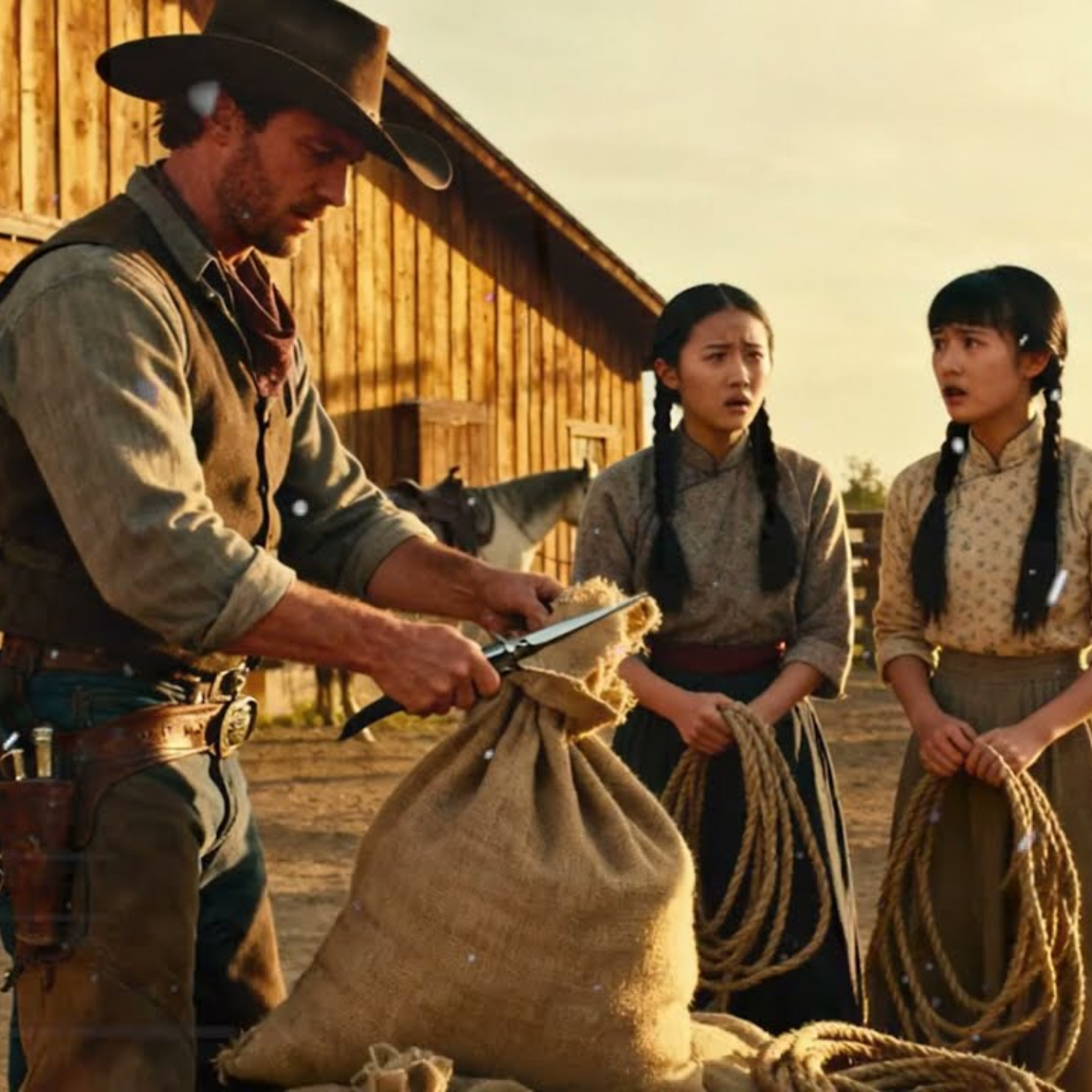
Without a word, Clara led them to her horse, her heart pounding in her chest. What had she done? What would she do next?
The ride back to her ranch was silent. The boys sat in the back of her buckboard, their eyes fixed on the road, each lost in his own thoughts. Clara didn’t ask them questions, nor did she offer food or comfort. She knew better than to rush the process. Comfort could be a frightening thing for those who had been hurt the most.
Clara’s ranch sat on the edge of the foothills, the pines tall and the creek running swiftly beneath them. The land was hers, solitary and quiet, untouched by the bustle of the outside world. The boys didn’t move when she stopped the cart. “Inside,” she said, and the eldest boy jumped down first, helping the others without a word.
The small cabin was warm from the fire she had left burning. She set the kettle on, prepared some food, and laid out blankets for them to sleep on. “You sleep here tonight,” she told them, “clean clothes are in the chest. If you run, I won’t come after you, but I’ll leave the lantern on until morning.”
The youngest boy looked up at her, hesitant. “Can I keep my name?” he asked in broken English.
“Why wouldn’t you?” Clara replied.
“People change them,” he muttered, looking down at his hands.
“Well, I won’t,” Clara said firmly, her gaze unwavering.
By morning, the boys had started to settle in. Clara had begun to establish a routine—something simple, but necessary. They worked together, folding linens, washing in the barn, and tending to the land. It wasn’t perfect, but there was a warmth in the house that hadn’t been there in years.
One night, Clara found Bo, the eldest, sitting on the porch, staring into the dark. “I’m not going back,” he said, his voice trembling.
“None of us are,” Clara answered, sitting beside him. “Tomorrow, you just tell the truth.”
The next day, they all went to the sheriff’s office to make things official. But Clara knew the truth—that these boys were hers now, and she would protect them with everything she had. But she also knew that there was someone who would come to take them away.
Sheriff Broady arrived with unsettling news. “I’ve got a man asking about the boys,” he said grimly. “Claims he’s their owner.” The man was from the railroad company, and his papers were official. But Clara wasn’t about to hand over the boys who had chosen her as their protector.
“I’ll make new history,” Clara vowed, her voice firm.
The man returned, his pale face twisted in anger. He claimed to have purchased the boys from the railroad, but Clara wasn’t having it. She stood her ground, rifle in hand, ready to defend what was rightfully hers.
The company’s lawyer arrived with a letter demanding that the boys be returned, but Clara refused. She would not give them up. Not without a fight.
And so, the battle began—words over rifles, ownership over family. The judge, initially skeptical, was swayed by the boys’ words. “We are not property,” the youngest, Wei, had said. “She is our mother.”
And just like that, Clara won. The contracts were dissolved, and guardianship was granted to her.
But the trouble wasn’t over. Days later, Clara found herself standing before the judge once again, this time in a courtroom. The company was determined to take back what they thought was theirs. But the truth of the boys’ lives—lives they had built together, lives they had chosen for themselves—was all that mattered.
The judge’s gavel came down, and the boys were freed. They were not property; they were family. And that was a bond nothing could break.
Clara’s home had become a sanctuary for them—a place where they could live and grow without fear. The battle for their freedom was over, but a new journey had just begun. Together, they would make their own history.
News
“Los Matones Abofetearon a un Niño Discapacitado y Negro Sin Hogar en un Restaurante — Entonces, Dos Ángeles del Infierno Intervinieron”
“Los Matones Abofetearon a un Niño Discapacitado y Negro Sin Hogar en un Restaurante — Entonces, Dos Ángeles del Infierno Intervinieron” Era una mañana común en un pequeño restaurante local, donde el bullicio de los comensales y el tintinear de…

“Inconsciente de que Su Débil Esposa Era una Maestra Entrenada de Kung Fu—La Golpeó y Se Burló de Ella, Ella Se Encargó de Él”
“Inconsciente de que Su Débil Esposa Era una Maestra Entrenada de Kung Fu—La Golpeó y Se Burló de Ella, Ella Se Encargó de Él” En una tranquila ciudad, donde las vidas de las personas parecían seguir una rutina predecible, un…

“Hijo de Multimillonario Vierte Café Caliente sobre Camarera—No Vio al Jefe de la Mafia Coreana y a su K9 Detrás de Él”
“Hijo de Multimillonario Vierte Café Caliente sobre Camarera—No Vio al Jefe de la Mafia Coreana y a su K9 Detrás de Él” Era una tarde aparentemente tranquila en el lujoso restaurante de la ciudad, un lugar frecuentado por empresarios, políticos…
“La Camarera Tímida Saludó al Padre Siciliano del Jefe de la Mafia—Su Saludo en Dialecto Siciliano Dejó Congelados a Todos los Invitados”
“La Camarera Tímida Saludó al Padre Siciliano del Jefe de la Mafia—Su Saludo en Dialecto Siciliano Dejó Congelados a Todos los Invitados” La elegante cena en el lujoso restaurante de la ciudad transcurría como cualquier otra noche tranquila, con la…

“Le Lanzó Café a Ella. Luego, El Jefe de la Mafia Coreana Cerró las Puertas”
“Le Lanzó Café a Ella. Luego, El Jefe de la Mafia Coreana Cerró las Puertas” En un elegante café del centro de la ciudad, un incidente aparentemente menor desató una cadena de eventos que cambiaría el destino de todos los…
“Dejó Entrar a un Niño Hambriento en su Restaurante—Sin Saber Que su Padre Era el Jefe de la Mafia Más Temido”
“Dejó Entrar a un Niño Hambriento en su Restaurante—Sin Saber Que su Padre Era el Jefe de la Mafia Más Temido” En una tranquila tarde en un pequeño restaurante de barrio, algo sucedió que cambiaría la vida de la dueña…
End of content
No more pages to load